
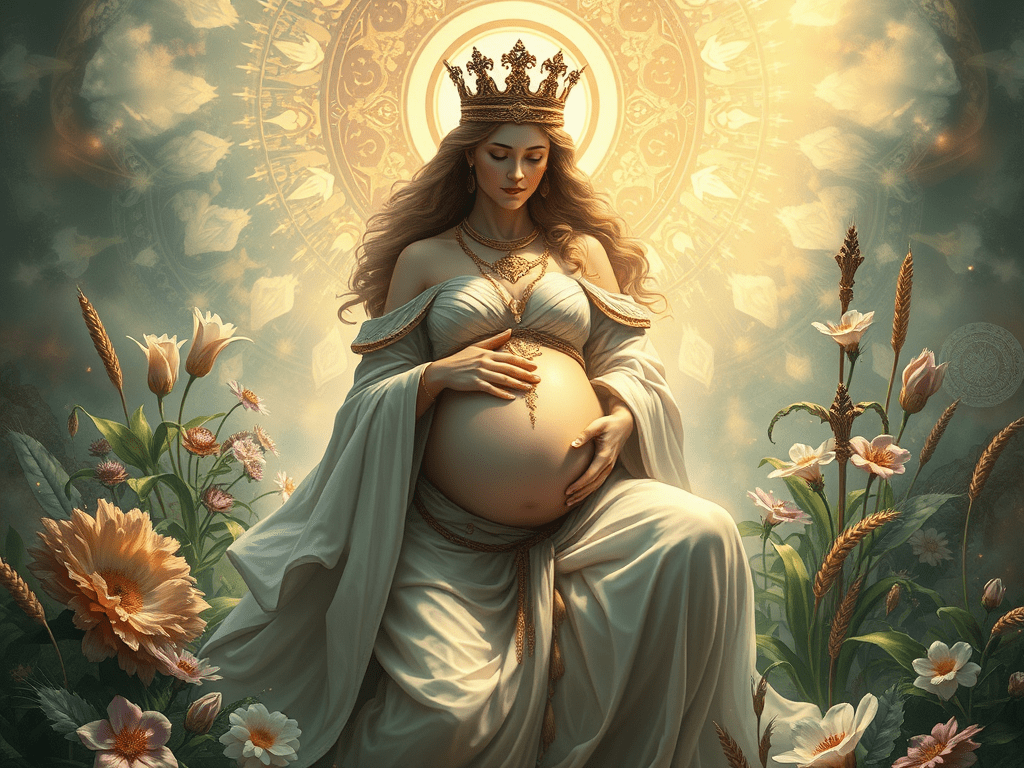
The Empress card in the Tarot is a rich tapestry woven with threads of history, mythology, and evolving cultural values. Often depicted as a regal woman, sometimes pregnant, surrounded by symbols of fertility and abundance, the Empress is far more than just a pretty picture. She embodies the potent feminine principle, reflecting the power and influence of women and goddesses across diverse cultures and eras. This post delves deeper into her historical roots, exploring the figures and ideas that have shaped her symbolism and meaning.
The Divine Feminine: Ancient Goddesses as the Wellspring of Life
Before the rise of patriarchal religions, many ancient cultures revered powerful mother goddesses as the original source of creation and life. These goddesses weren’t simply symbols of fertility; they embodied the very essence of the feminine principle – nurturing, creativity, and a deep connection to the earth.
- Isis: The Egyptian goddess Isis, worshiped from Neolithic times, was known as the “Lady of Life” and a powerful magician. Her cult endured for centuries, extending into the Greek and Roman worlds. She was not merely a mother figure, but a symbol of wisdom and power.
- Cybele: Originating in prehistoric Phrygia, the Great Mother Cybele was passionately revered in Italy for over half a millennium. She represented the untamed forces of nature and the power of the earth.
- Demeter: The Greek goddess Demeter, a source of both life and death, is often depicted holding stalks of wheat to represent the growth of grains, and the bounty of the earth. Her story emphasizes the vital role of the feminine in agriculture and sustenance.
- These ancient goddesses provide a foundation for understanding the Empress as more than just a maternal figure. She is a representation of the primordial feminine power that gives birth to all of creation.
- Gnostic writings describe an “All-Maternal Being,” a Kali-like Christian Goddess that was carefully concealed by later editors of the canon. This shows that the divine feminine was part of Christian thought but later suppressed.
The Papess: A Precursor or Counterpart to the Empress?
The Papess, another Major Arcana card associated with the divine feminine, often appears as a nun, abbess, or a female pope, wearing a papal tiara decorated with a crescent moon. She’s often depicted holding a book, symbolizing wisdom and teaching. Understanding the Papess provides insights into the historical roles of women in religious life and their connection with both spiritual and temporal power.
- The pagan tradition of feminine spiritual authority remained strong within Christianity up to the 13th century, with women holding positions of power within the church. This suggests a continuity of feminine authority even as patriarchal structures took hold.
- The legend of Pope Joan, a woman who purportedly reigned as pope, speaks to this hidden history, even though official church histories try to erase her from the record. This tale highlights the potential for women to hold positions of power, even within patriarchal systems.
- The Papess can be seen as a figure of hidden knowledge, while the Empress is a figure of manifest power, each representing different aspects of the feminine.
Symbolism and Shifting Meanings: The Empress in Context
The symbolism of the Empress card is not static; it has evolved alongside the shifting social and political landscape. Understanding these shifts can reveal new layers of meaning.
- Left/Female, Right/Male: The Emperor is often shown in profile, looking towards his Empress, displaying his left, or feminine, profile. This ubiquitous left/female, right/male symbolism has a long history and speaks to the dynamic interplay between masculine and feminine energies. The idea of the left side as feminine was long held in the west.
- Post-Revolutionary Revisions: During the post-revolutionary period in France, the Empress card was sometimes renamed “Grandmother”. This shift reflects a period when imperial titles were out of favor and may point to a cultural memory of the “Grandmother” or “Great Mother” archetype. It also highlights the fluid nature of the Tarot’s symbolism, adapting to changing cultural values.
- The Goddess as Glory: In the Mithraic Mysteries, an emperor’s right to rule was embodied in his Goddess under her name of Glory. This concept connects the Empress to the idea of divine authority and the power associated with the feminine.
The Empress in Historical Decks: Visconti Cards and Beyond
The Empress card is not a recent invention but has roots in early Tarot decks, providing clues to the card’s original significance:
- Visconti Decks: The Empress was included in both the Visconti di Modrone and Visconti-Sforza decks. In both cases, she was depicted wearing the imperial eagle of the Holy Roman Empire, indicating an association with power and authority.
- In the Visconti di Modrone deck, she was also accompanied by two ladies-in-waiting, highlighting her status and entourage.
- The low ranking of the card may reflect the Visconti family’s negative view of the Holy Roman Empire.
- The Visconti family’s association with the cards: The Visconti family’s rule of Milan was largely shaped by both good and bad fortune. Conspiracies, strategic marriages, unstable military alliances, and the vagaries of the Church all played a role in their family’s history. This suggests that the cards may have been a way for the family to understand their history, their lives, and the nature of fate itself.
Conclusion: The Enduring Power of the Empress
The Empress card is a potent symbol, far more complex than a simple depiction of womanhood. She is a historical figure who reflects the enduring influence of goddesses, religious figures, and shifting cultural values.
- She embodies the divine feminine: A source of creativity, fertility, and life itself.
- She mirrors social values: Her representation shifts to reflect societal changes, like post-revolutionary France.
- She connects us to history: By understanding the Empress’s roots in mythology and history, we gain a richer appreciation of the Tarot’s symbolism and its enduring power.
The Empress is a reminder that the feminine principle is not a passive force but an active, creative, and powerful presence throughout history and in our own lives. By looking beyond the surface, we can access the wisdom and strength she embodies, connecting us to a rich tapestry of human experience and understanding.
 Ink & Oracle
Leave a comment