

The strange, wonderful moment when imagination develops a mind of its own.
Have you ever been writing a story when one of your characters suddenly did something you hadn’t planned? Perhaps your quiet, sensible heroine picked a fight. Your villain showed an unexpected moment of kindness. Or two characters who were supposed to despise each other developed an undeniable connection.
You stare at the page, wondering where on earth that came from. You created these people. You know their histories, their secrets, their fears. So why aren’t they cooperating? Welcome to one of the strangest and most delightful experiences in creative writing: the moment your characters seem to come alive.
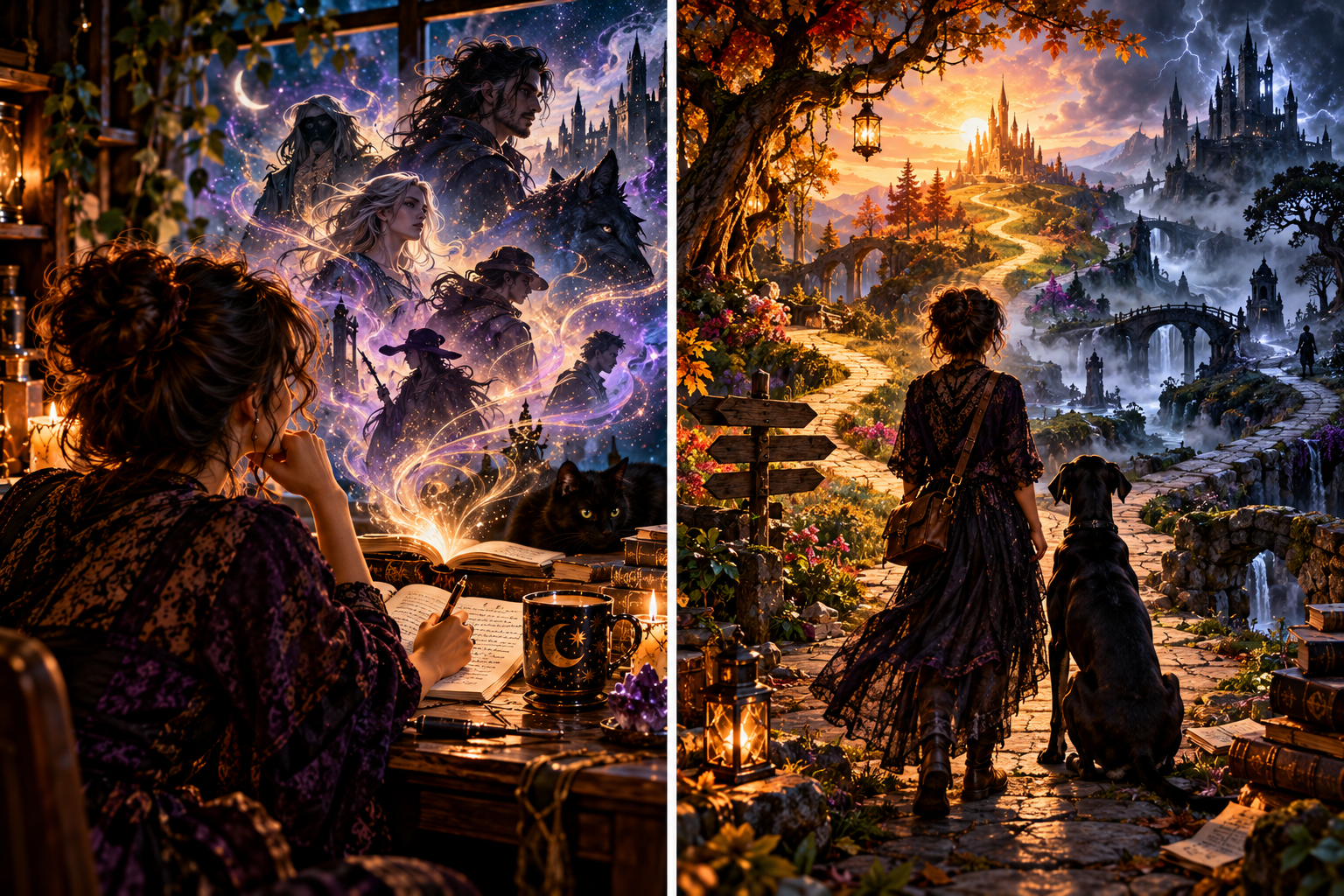
The Characters Who Refuse to Behave
Most writers begin with some kind of plan. Maybe it’s a detailed outline with every chapter mapped out. Maybe it’s nothing more than a character, a setting, and the vague suspicion that something terrible is about to happen. Either way, we usually believe we’re in charge. Until we’re not.
A character refuses to forgive someone. A minor character becomes unexpectedly important. A carefully planned romance falls apart because the people involved simply don’t seem right for each other. Writers sometimes describe these moments as though their characters have developed independent personalities.
In a creative sense, they have. Not because fictional people are secretly alive somewhere inside our minds, but because we’ve imagined them deeply enough that our brains can begin predicting their behavior without consciously working through every decision. We stop asking, What do I want this character to do? Instead, we begin asking, What would this character actually do?
Your Brain Is a Storytelling Machine
Human beings are remarkably good at imagining other minds. Every day, we make predictions about what people are thinking, feeling, and likely to do next. Psychologists often discuss this ability in terms of theory of mind, our capacity to understand that other people have beliefs, desires, and perspectives different from our own.
Writers put that ability to work constantly. When you create a character, you gradually build an internal model of that person. You imagine their childhood, disappointments, ambitions, and the things they would never admit aloud. Eventually, you may know them so well that their reactions begin to feel automatic.
Imagine someone insulting your protagonist’s closest friend. You might not need to calculate how your protagonist will react. If you’ve developed the character thoroughly, you may already sense whether they’ll laugh, walk away, or throw the first punch. The character isn’t making decisions independently. Your mind has become exceptionally good at imagining how they would decide.
The Curious Science of Hearing Characters
Some writers report experiences that go beyond predicting a character’s behavior. They describe hearing a character’s voice while writing, sensing their presence, or feeling as though a character has offered an unexpected opinion.
Researchers associated with Durham University’s Hearing the Voice project explored such experiences among fiction writers. Respondents described characters who seemed to possess their own voices, personalities, or intentions, sometimes even resisting the planned story. These accounts don’t establish that fictional characters have independent consciousness. They do show how surprisingly autonomous our imaginative experiences can feel.
When the Story Finds a Better Path
Our conscious plans aren’t always our best ideas. An outline follows logic: this must happen so that can happen. But when we’re actually writing, we’re also processing emotion, memory, personality, dialogue, and subtle relationships. Sometimes those elements reveal that our original plan no longer fits.
Maybe the character you’ve spent ten chapters developing would never commit the betrayal you planned. Maybe the person you intended to kill has become essential to the emotional heart of the story. That’s not necessarily a failure of planning. It may mean your story has developed enough depth to challenge its original structure.
Should You Always Follow Your Characters?
Not necessarily. Characters can surprise us, but they can also lead us straight into a narrative swamp. A fascinating conversation might contribute nothing to the plot. An unexpected romance might distract from the central conflict. Writers still need judgment.
Think of your outline as a map and your characters as travelers. The map tells you where you intended to go. The travelers reveal what happens along the way. Sometimes a detour leads somewhere extraordinary. And sometimes you have to remind everyone that the story cannot spend forty pages discussing breakfast.
The Magic of Not Knowing Everything
There’s a particular pleasure in writing a scene without knowing exactly how it will end. You place your characters in a room. You give them conflicting desires. You let them speak. One says something unexpected. Another responds in a way you hadn’t anticipated. Suddenly a secret appears, an argument erupts, or an entirely new possibility opens.
For a moment, you’re not simply constructing a story. You’re discovering one. Of course, the world is still being created by your imagination. But discovery and invention aren’t opposites. Sometimes we invent our way into discoveries we couldn’t have planned.
Try This: Let Your Character Surprise You
Choose a character you think you know well. Place them in a situation that isn’t part of your current story. Perhaps they find a letter addressed to someone who died years ago. Perhaps a stranger approaches and says, I know what you did. Now write for ten minutes.
Three rules: Don’t outline what happens first. Don’t force the character toward a particular ending. And when they do something unexpected, follow it for a little while.
Afterward, ask yourself: Did you discover a fear, desire, or contradiction you hadn’t noticed? Did something emerge that might belong in your actual story? You don’t have to keep the scene. The purpose is to explore the person you’ve imagined.
The Writer Is Still Holding the Pen
There’s something beautifully contradictory about creating fictional people. We give them personalities, histories, desires, and dreams. Then we become delighted when they refuse to do what we tell them.
The next time your carefully planned scene wanders in an unexpected direction, don’t immediately drag it back. Follow it for a few paragraphs. See where it goes. Sometimes the most exciting moment in writing is when the author gets surprised, too.
A Question for the Ink & Oracle Community
Have you ever had a character completely change your story? Maybe they refused to fall in love, revealed a secret you hadn’t planned, or somehow survived a scene where they were absolutely supposed to die. Tell us about your most rebellious fictional creation.
Further Reading
Durham University, Hearing the Voice, research into inner speech and writers’ experiences of fictional characters. Also see Scott Barry Kaufman and Carolyn Gregoire’s Wired to Create: Unraveling the Mysteries of the Creative Mind.


Leave a comment