
The Origin of “Christmas”: A Holy, Jolly Word History
Ah, Christmas. The season of glittering lights, endless cookie platters, and frantic Amazon Prime orders. But have you ever paused amid the holiday madness to wonder where the word Christmas came from? Let’s unwrap the linguistic history of this festive term—with a few laughs along the way.
Christ’s Mass: The Humble Beginnings
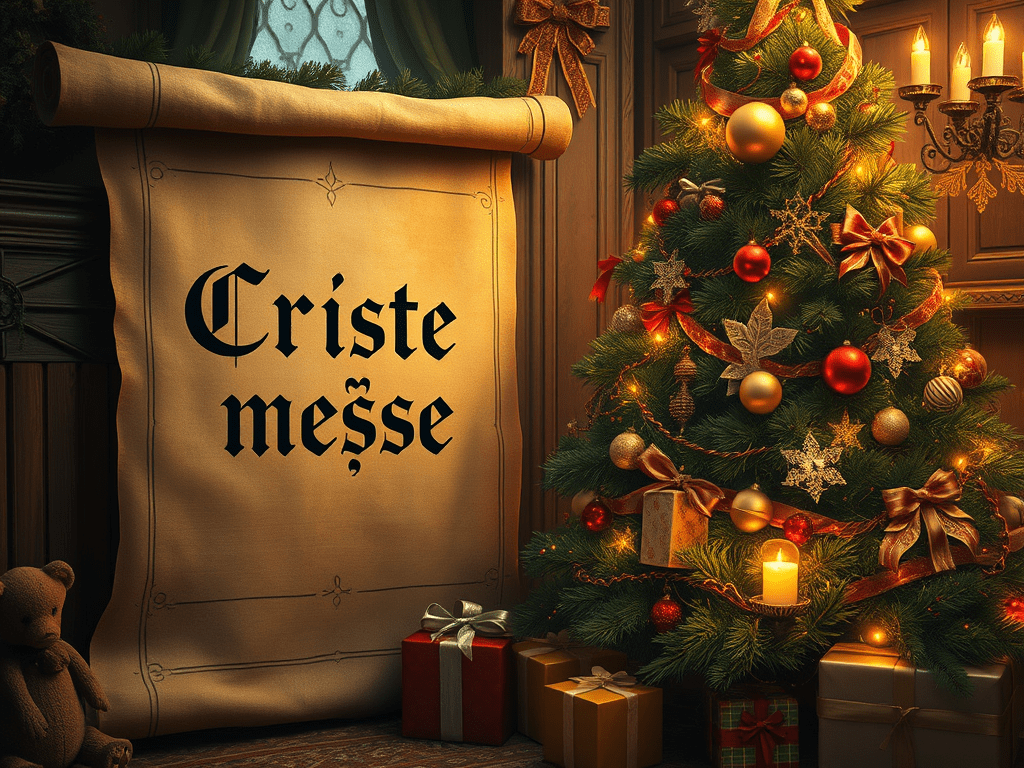
Our story begins in Old England (cue the medieval lute music), where the phrase Cristes mæsse first appeared around 1038. Translated, it means “Christ’s Mass,” referring to a special church service in honor of Jesus’ birth. Back then, this was a solemn religious occasion—no stockings, no eggnog, and definitely no ugly sweaters.
The “Christ” part comes from the Greek word Christos (Χριστός), meaning “anointed one,” which itself translates the Hebrew term Messiah. Meanwhile, mæsse (mass) derives from the Latin missa, a term used in church services. And just like that, Cristes mæsse became the original RSVP for humanity’s most celebrated birthday party.
When “X” Marks the Spot
Fast forward to the Middle Ages, where people were already looking for shortcuts—apparently, “Cristes mæsse” was just too much to scribble on parchment. Enter Xmas!
Now, before you accuse our medieval friends of waging a war on Christmas, let’s clarify: the “X” isn’t an attempt to “cancel” Christ. It’s actually the Greek letter chi (Χ), the first letter of Christos. So, using “Xmas” was essentially an ecclesiastical emoji. Ancient monks would’ve slayed it on Twitter.
Christmas’ Global Cousins and Celebrations
Like any superstar, Christmas has its own entourage of international aliases. While English speakers stuck with “Christ’s Mass,” other cultures got creative:
- Spanish: Navidad (from natividad, meaning “nativity”).
- French: Noël (from the Latin natalis, meaning “birth”).
- Italian: Natale (same root as French Noël).
Each of these names highlights the birth of Jesus while adding a local twist. For example, in Spain, Navidad often includes lively nativity reenactments and feasts, while in France, Noël brings us the tradition of the bûche de Noël (Yule log cake). It’s like the linguistic version of regional Christmas recipes—one word, many flavors.
From Solemn to Sparkly
For centuries, Christmas was a quiet, solemn affair—more about midnight masses and less about decking the halls. Things started to shift in the 4th century when the church declared December 25th as the official date of Christ’s birth. This conveniently aligned with existing pagan celebrations like the Roman Saturnalia (a festival of feasting and gift-giving) and solstice rituals.
Let’s be honest: merging Christmas with Saturnalia was a marketing genius move. Who doesn’t love a holiday mash-up? By borrowing some of those “pagan party vibes,” Christmas evolved into the festive powerhouse we know today.
Fun Fact: The Yule Connection
Speaking of party vibes, the word Yule often pops up around Christmas. This term comes from the Old Norse jól, a pre-Christian festival celebrating the winter solstice. The tradition of burning a Yule log (and, later, eating Yule logs in cake form) is a nod to these ancient midwinter feasts. Basically, Yule walked so Christmas could run.
Modern Christmas: A Holiday for All
Today, Christmas is a word that carries different meanings for different people. For some, it’s a time of religious devotion; for others, it’s an excuse to binge-watch Hallmark movies in their pajamas. In Japan, for example, Christmas is celebrated with KFC and cakes, a unique twist on Western traditions. The beauty of Christmas lies in its adaptability—a term rooted in sacred traditions that’s grown to encompass joy, generosity, and a hefty dose of tinsel.
So, What’s in a Word?
The next time you say “Merry Christmas,” remember that you’re invoking over a thousand years of history. Whether you prefer “Christmas,” “Xmas,” or even “Yule,” it’s all about celebrating the season—with a little linguistic flair.
What about you? Do you have a favorite Christmas tradition or know a unique word for the holiday from your culture? Share it in the comments below! Now, go forth and spread some holiday cheer, armed with the knowledge that Christmas is more than just a word—it’s a testament to the enduring power of human tradition and our love of a good party.
Merry Cristes mæsse, everyone!
Sources
- Oxford English Dictionary, “Christmas”
- Merriam-Webster, “Christos”
- Encyclopedia Britannica, “Mass”
- The Viking World by Stefan Brink and Neil Price
- History.com, “The History of Christmas”
- BBC, “Why Do Japanese People Eat KFC on Christmas?”
 Ink & Oracle
Leave a comment